
Room 32 | India 600-1900 gallery
Explore Hindu, Buddhist and Jain art from India, the Himalayas and Southeast Asia.
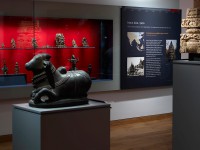
Southeast Asia
Maritime trade between India and Southeast Asia began at an early date. As Indian merchants settled in many parts of this widespread region they brought with them the practice of Buddhism and Hinduism. Local ruling dynasties both adopted these religions and began to patronise Indian styles of temple architecture and sculpture. Indian models were skilfully assimilated by their artists and reinterpreted in powerful and elegant styles of their own, reflecting local physical types and costume.
Great surges in building activity, going far beyond Indian precedents, produced awe-inspiring temple complexes such as Borobudur in Java (AD 800) and Angkor in Cambodia (1150). Strong cultural influences from China were also reflected in the production of Chinese-style glazed ceramics in several regions.
Dongson bronzes
 Anthropomorphic lime spatula (EA1997.184)
 Bronze hilt (EA1999.23)
 Long ribbed bracelet (EA1997.197)
 Amulet in the form of a beetle (EA1999.35)
 Amulet in the form of a water-buffalo (EA1999.36)
 Amulet in the form of a deer (EA1999.37)
 Amulet in the form of a bird (EA1999.38)
 Small bronze drum (EA2000.103)
 Jade ear ornament (EA1996.90)
Khmer sculpture
 Torso of the Muchalinda Buddha (EA2002.41)
 Buddhist monk’s handbell with vajra (EA1997.237)
 Figure of Maitreya, the future Buddha (LI1061.4)
 Figure of the Buddha (EA1999.94)
 Plaque with a seated bodhisattva (EA1996.106)
 Figure of four-armed Shiva (EA1998.7)
 Dancing apsara, or celestial beauty (EA2000.33)
 Torso of Vishnu (EA2001.15)
 Silver amulet in the form of the Buddha (EA1997.233)
 Seated figure of the Buddha (EA1999.48)
 Buddhist monk’s handbell with vajra, symbol of a thunderbolt and diamond (EA1997.238)
Thai sculpture
 Seated figure of the Buddha (EA2002.42)
 Head of the Buddha (EA1999.91)
 Votive plaque depicting the miracle of Sravasti (EAX.170)
 Votive plaque of the Buddha surrounded by pipal leaves (EAX.2379)
Burma
 Figure of the Buddha with female attendants (EA2013.79)
 Seated figure of the Buddha (EA2013.78)
 Figure of Surya, the Sun god, in his chariot (EA2013.56)
 Glass miniature stupa (EA1996.11)
 Glass figure of the Buddha (EA1996.10)
 Seated figure of the Buddha (EA2002.45)
 Seated figure of the Buddha (EA2002.20)
 Silver head of the Buddha (EA2002.17)
 Figure of the Akshobhya Buddha (EAX.411)
 Votive plaque depicting scenes from the Buddha’s Life (EAX.415)
 Votive plaque with multiple seated Buddhas (EAX.421)
Early Java
 Figure of six-armed Avalokiteshvara (EA2013.80)
 Standing figure of Sujata (LI1061.3)
 Standing figure of a bodhisattva (EA1997.232)
 Standing figure of the Buddha (EA1997.229)
 Figure of Jambhala or Kubera, god of plenty (EA1991.65)
 Bronze handbell with winged conch finial (EA1991.68)
 Seated figure of the Buddha (EA2002.46)
 Seated figure of Avalokiteshvara (EA1997.239)
 Seated figure of Ganesha (EA2002.49)
 Torso fragment of Durga (EA2002.15)
 Seated figure of Ganesha (EA2002.50)
 Handbell with bull finial (EA1997.234)
 Gold figure of the Buddha (LI1061.1)
 Seated figure of the Buddha (LI1061.2)
Java and Sumatra
 Fitting with kala head (EA1997.236)
 Bronze belt clasp with demon face (EA1991.72)
 Mirror-handle with Kadiri script (EA1991.71)
 Gold goblet (LI1061.5)
 Finial for a lamp or bell in the form of a singha lion (EA1997.235)
 Cauldron handle in the form of a kinnari (EA1997.230)
 Figure of four-armed Ganesha (EA1997.231)
Terracotta figurines from the Majapahit Kingdom, eastern Java, 1300-1500
 Head of a Chinaman (EA1997.228)
 Head of a young woman (EA1997.227)
 Female head (EA1995.163)
 Fragmentary figure of an elephant (EA1999.100)
 Female head (EA1996.14)
 Piggy bank (EA1997.5)
Southeast Asia: ceramics, terracottas and bronzes
 Plaque with elephant-headed warriors (EA1965.256)
 Bronze handbell (EA1991.66)
 Figure of ten-armed Shiva Maheshvara on the bull Nandi (EA1966.46)
 Figure of the Crowned Buddha with alms-bowl (EAX.2050)
 Bronze handbell with five-pronged vajra finial (EA1991.67)
 Bronze ritual tray (EA1991.70)
 Standing figure of the Buddha (EA2013.59)
Southeast Asia: ceramics
 Brown glazed jar (EA1978.198)
 Dark brown glazed dragon jar (EA1969.59)
 Greenware dish (EA1966.185)
 Greenware jar (EA1970.79)
 Greenware jar with dragons in relief (EA1966.186)
 Bowl with iron-black decoration (EA1965.56)
 Covered bowl (EA1980.124)
 Covered bowl with feather-floral designs (EA1965.55)
 Green and brown covered bowl (EA1969.2)
 Kendi with floral decoration (EA1974.74)
 Greenware figure of mother and child (EA1964.229)
 Greenware figure of mother and child (EA1980.133)
 Large end-tile in the form of a naga-makara (EA1969.75)
 Brown glazed rabbit lime-pot (EA1969.3)
 Brown glazed jar (EA1968.55)
 Kendi with floral decoration (EA1994.115)
 Blue-and-white jarlet (EA1969.56)
 Blue-and-white dish with floral decoration (EA1969.27)
 Figure of a tiger (EA1964.228)
 Figure of an elephant (EA1972.2)
 Duck water-dropper (EA1980.134)
 Figure of a humped cow (EA1968.29)
Small porcelain vessels from the Hoi An shipwreck, Vietnam, about 1450-1500
 Octagonal lidded box (EA2006.10)
 Small jar or water-dropper (EA2005.71)
 Small jar (EA2006.11)
 Circular lidded box (EA2006.9)
Freestanding sculpture
 Buddhist chaitya (EA1999.102)
 Standing figure of a rishi, or holy man (EA2007.105)
 Figure of eight-armed Durga slaying the Buffalo-demon (EA1999.10)
 Seated figure of the Buddha (EA2008.70)
 Lintel with kala face (EA1993.36)
Notice
Objects may have since been removed or replaced from a gallery. Click into an individual object record to confirm whether or not an object is currently on display. Our object location data is usually updated on a monthly basis, so contact the Jameel Study Centre if you are planning to visit the museum to see a particular Eastern Art object.
© 2013 University of Oxford - Ashmolean Museum