
Room 36 | Japan from 1850 gallery
Explore the major technical and creative developments in arts and crafts of Japan after 1850 and visit the Ashmolean's tea house.
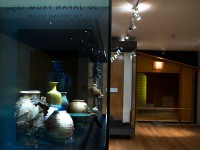
'Cherish old knowledge so that you can acquire new'
(Analects of Confucius)
Following the opening up of Japan, the government was eager to achieve equal status with the industrialized Western nations. Every effort was made to modernize Japan along Western lines. At the same time, official institutions and individuals alike also tried to preserve the best from Japan's past.
For Japanese artists this meant incorporating Western technology and designing their products to suit Western taste, while also drawing on their traditional skills. For example, makers of sword fittings adapted their metalworking skills to produce elaborate ornamental vases. Potters experimented with chemical glazes. Painters began to use oil paints and study Western art.
'Gorgeous with glitter and gold'
(E.S. Morse, 'Old Satsuma', Harpers New Monthly Magazine, 1888, describing Satsuma ceramics popular in the West at the time)
 Kyo-Satsuma dish with landscape using westernized perspective (EA1992.71)
 Baluster vase with a bear on a rock (EA1994.65)
 Vase depicting a ship in a stormy sea (EA1999.42)
 Lobed dish with a Chinese warrior (EA1995.116)
 Baluster vase with poppies and tree peonies (EA1994.109)
 Vase with scenes of a courtier and two attendants (EAX.5148)
 Vase with scenes of a courtier on a horse (EAX.5149)
 Hexagonal baluster vase with flowers and birds (EA2000.5.a)
 Hexagonal baluster vase with flowers and birds (EA2000.5.b)
 Satsuma tea bowl with animals, plants, and figures (EA1956.3987)
 Satsuma kōgō, or incense box, with chrysanthemums (EA1956.665)
 Satsuma cup with chrysanthemums and key pattern border (EA1956.681)
 Kyo-Satsuma vase with figures, flowers, and landscape scenes (EA1990.1237)
 Kyo-Satsuma bowl with flowers and butterflies (EA1967.23)
 Lidded box with geometric designs (EA1956.2016)
 Vase with procession celebrating the Seven Lucky Gods (LI1113.1)
 Box with a hydrangea flower (EA1956.3337)
 Vase with dragon amid waves (EA1999.104)
'Respect and preserve traditional art'
(Ryūchikai art society, early 1880s)
 Snowscape depicting a man walking towards a hermitage (EA1965.133)
 Mizusashi, or water jar, with maple leaves (EA1968.24)
 Vase with narcissi and a wagtail (EA1993.398)
'Japanese spirit, Western technology'
(Meiji government slogan)
 Lake in the Rain (EA1964.196)
 Suzuribako, or writing box, with cherry trees on a river bank (EA2007.258)
 Ryoshibako, or paper box, with maple trees and waterfall (EA2007.259)
 Figure of an Ainu fisherman with his catch (EA2008.8)
 Baluster vase with chrysanthemums (EA1990.5)
 Satsuma style vase depicting a bird perched on a cherry tree (EA1993.12)
 Baluster vase with chrysanthemums and a butterfly (EA1998.214)
 Art Nouveau style vase with chrysanthemums (EA1997.41)
See also

Notice
Objects may have since been removed or replaced from a gallery. Click into an individual object record to confirm whether or not an object is currently on display. Our object location data is usually updated on a monthly basis, so contact the Jameel Study Centre if you are planning to visit the museum to see a particular Eastern Art object.
© 2013 University of Oxford - Ashmolean Museum